
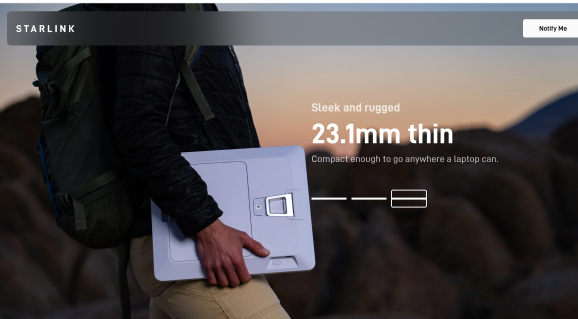
After months of speculation among tech enthusiasts and the off-grid community, SpaceX officially unveiled the Starlink Mini 2 on November 10, 2026. This second-generation portable satellite dish directly addresses the biggest complaint from first-generation users by integrating an official swappable battery and upgraded Wi-Fi 6 connectivity.
However, the launch came with a major pricing plot twist. While an earlier leak found in Starlink’s website code pointed to an affordable $249 price tag, SpaceX opened early-adopter invite pre-orders at $999. Why is there such a drastic price difference, and what technical upgrades does the Starlink Mini 2 bring to the table?
The $249 API Code Leak vs. The $999 Bundle Reality
Prior to the official announcement, hardware tracker and YouTube channel DISHYtech uncovered hidden references in the backend API code on Starlink.com. The code listed products named "Mini 2 Beta" and "Mini 2 Beta Kit" priced at $249, alongside an accessory labeled "us-mini-2-battery-beta" for $50 with the description: “Mini 2 battery. Stay connected for longer.”

When SpaceX officially sent out initial order invitations to select existing subscribers in the United States, the price listed in the invite email was $999 (requiring a $100 refundable deposit, with the remaining $899 plus tax due upon shipment in mid-December 2026).
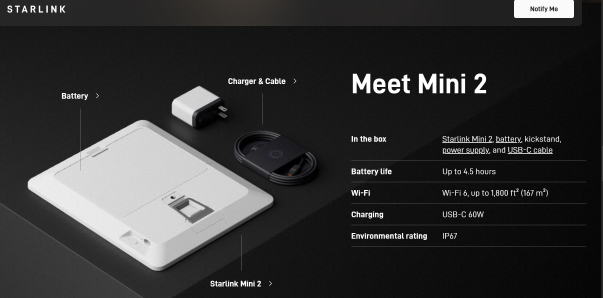
Why Does It Cost $999? Breaking Down the Value: That $999 figure isn’t for the hardware alone—it is an exclusive early-adopter bundle that includes:
- 1x Starlink Mini 2 Dish with the official swappable battery included.
- 1 Year of Free Starlink Roam Unlimited Service, which SpaceX states is valued at $2,100 annually.
When breaking down the pricing structure, customers who already plan to subscribe to the Roam Unlimited plan for a full year are actually getting a massive subsidy. Meanwhile, the $249 dish price (and $50 for spare batteries) discovered by DISHYtech strongly indicates the standalone retail hardware price that will roll out once the early-adopter exclusivity period ends and general retail sales begin. SpaceX used a similar playbook when launching the first-generation Starlink Mini in 2024, which initially debuted at $599 via invite-only before dropping to $249—and eventually getting discounted to $149 ahead of the holiday season.
Key Upgrades on the Starlink Mini 2: What’s New?
Based on official specifications released by SpaceX and technical coverage from PCMag and Notebookcheck, the Starlink Mini 2 introduces functional design overhauls tailored for extreme mobility:
1. 4.5-Hour Swappable Battery
On the first-generation Starlink Mini, the lack of an internal battery forced users to rely on third-party power banks (such as PeakDo) and deal with external cables. The Starlink Mini 2 includes a rectangular 71 Wh battery (weighing 490 grams / 1.08 lbs) that snaps directly onto the back of the dish using a tool-free, quick-release mechanism.
- Battery Life: Delivers up to 4.5 hours of continuous operation on a single charge.
- Power Flexibility: The battery features its own dedicated LED charge status indicator and a USB-C port. The dish can still be powered directly via a USB-C cable (60W) even with the battery removed. A 60W wall adapter and a 3-meter (9.8 ft) USB-C cable are included in the box.
2. Wi-Fi 6 Router Upgrade and 60-Second Boot Time
The Starlink Mini 2 ditches the integrated Wi-Fi 5 modem of its predecessor in favor of built-in Wi-Fi 6. This upgrade delivers better data transmission efficiency across multiple connected devices, covering an area of up to 167 square meters (1,800 sq ft). SpaceX also added a physical power button (replacing the old plug-and-boot setup) and claims the dish can connect to satellites in roughly 60 seconds once it has a clear view of the sky.
3. Thinner, Ruggedized Design (IP67)
Dimensionally, the face of the Starlink Mini 2 is slightly wider but about 0.5 inches thinner (measuring under an inch thick at 23.1 mm) than the first generation. It carries an IP67 rating for protection against heavy dust and light water submersion, features a folding kickstand, and includes a built-in 1/4″-20 standard tripod thread for easy outdoor mounting.
Spec Comparison: Starlink Mini 2 vs. Starlink Mini (Gen 1)
To help Exploraphones readers see the differences at a glance, here is how the two generations stack up:
| Specification | Starlink Mini (Gen 1) | Starlink Mini 2 (Gen 2) |
| Official Battery | None (relies on third-party power banks) | 71 Wh Swappable Battery (up to 4.5 hours runtime) |
| Wi-Fi Standard | Wi-Fi 5 (802.11ac) | Wi-Fi 6 (802.11ax), up to 1,800 sq ft coverage |
| Physical Dimensions | 298.5 x 259 x 38.5 mm (11.75 x 10.2 x 1.45 in) | 314 x 263 x 23.1 mm (12.36 x 10.35 x 0.91 in) |
| Total Weight | ~1.1 kg (2.43 lbs) | 1.6 kg (3.53 lbs) with battery & kickstand (~1.11 kg without battery) |
| Ports & Power Input | DC Barrel Jack (12–48V car adapter compatible) | 60W USB-C (includes 60W charger & 3m cable) + DC Input |
| Extra Physical Features | Standard kickstand | Physical Power Button, 1/4″-20 Tripod Thread, IP67 Rating |
| Current Pricing | $249 MSRP (currently discounted to $149) | $999 (Invite-Only Bundle + 1-Yr Roam Unlimited) / Est. $249 (Dish Only) |
Buyer’s Guide: Buy the Gen 1 Starlink Mini Now or Wait for the Mini 2?
With SpaceX slashing the first-generation Starlink Mini down to $149 and offering a 30% discount on monthly Roam plan rates, prospective buyers face two compelling options:
- Buy the Starlink Mini Gen 1 ($149) if: You want an emergency backup satellite internet solution or only use it occasionally for weekend camping trips. You can easily pair the $149 Gen 1 dish with your own 100W USB-C PD power bank and save hundreds of dollars upfront without committing to a $999 bundle.
- Wait for (or Grab) the Starlink Mini 2 if: You are a digital nomad, field journalist, or expedition crew member who relies on satellite internet daily while on the move (including in-motion use up to 100 mph / 160 km/h with the Roam Unlimited plan). Its cable-free portable setup, ability to hot-swap $50 spare batteries in seconds, and faster Wi-Fi 6 performance make the Mini 2 a far more practical long-term work investment.
Currently, Starlink Mini 2 orders remain limited to invite-only customers in the United States, with shipments scheduled to begin in mid-December 2026 before expanding to global markets.
E-E-A-T Optimization Notes for Publishing on Exploraphones.com
To help this article rank effectively on Google Search and Google Discover in line with Google E-E-A-T (Experience, Expertise, Authoritativeness, Trustworthiness) guidelines:
- Source Transparency (Trustworthiness): Include outbound links to primary sources such as the official
@StarlinkX announcement, the API teardown video by DISHYtech, and verification reports from PCMag and Notebookcheck. - Author Bio (Expertise): Publish the article under an Exploraphones author profile that includes a brief bio highlighting experience covering telecommunications, networking hardware, or consumer tech.
- Local Context Updates (Experience): Once standalone retail pricing or regional availability rolls out globally, add a brief Update Log section detailing regional pricing and local certification status.