
We Asked 919 Carrier Users What Would Make Them Switch to Starlink Mobile – The Answer Is Clear
Starlink Mobile is not officially a standalone carrier yet. But if our poll of 919 T-Mobile, AT&T, Verizon, and MVNO users is any indication, the Big Three should be paying attention.
We asked a simple question: What would make you switch to SpaceX’s Starlink Mobile? The result was not even close.
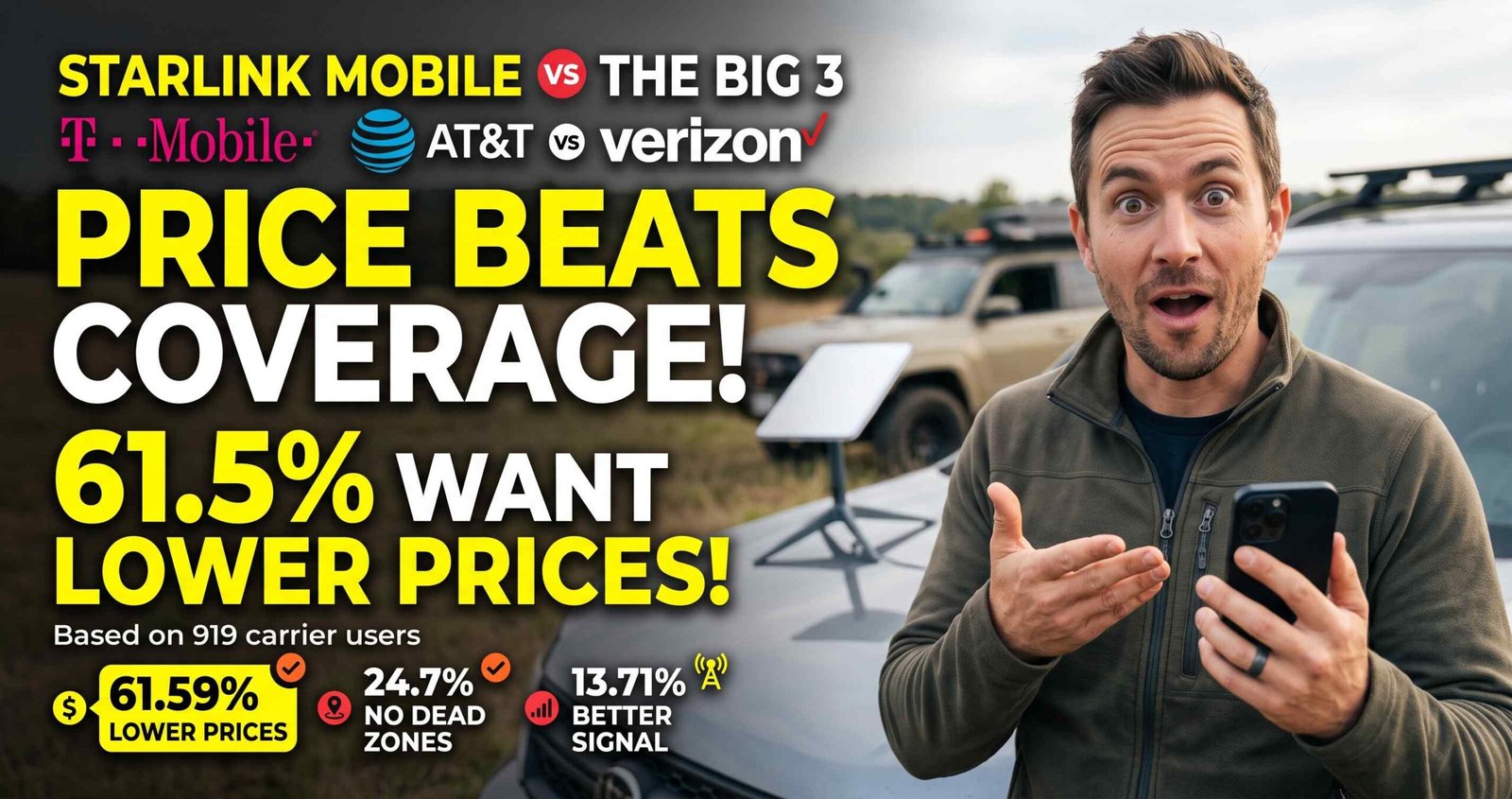
Quick Answer: 61.59% of respondents said lower prices would make them switch. No dead zones came second at 24.7%, and better signal quality was last at 13.71%.
The Poll: What We Found After 919 Votes
We ran this poll across our audience of rural internet users and off-grid testers in the US from September 28 – October 5, 2026.
- Lower prices: 61.59% (566 votes)
- No cell dead zones: 24.7% (227 votes)
- Better quality signal: 13.71% (126 votes)
- Why this matters: This mirrors what we hear daily in the field. For the past two years, we have been testing Starlink hardware in areas where the Big Three struggle – remote islands, dense forests, and RV parks in South Sulawesi and rural US. The number one complaint we hear from T-Mobile and Verizon users is not coverage, it is price hikes happening 2-3 times per year.
Why Price Is King in 2026
This result did not surprise us.T-Mobile, AT&T, and Verizon all raised plan prices in 2024, 2025, and again in early 2026. Even T-Mobile, which marketed itself as the “Un-carrier,” introduced new fees.
Starlink’s current strategy is the opposite: cut hardware aggressively to grow users. We verified this ourselves:
- Starlink Mini: $599 at launch (June 2024) -> $149 today
- Standard Kit: $599 -> $349 today
If SpaceX applies the same playbook to Starlink Mobile – subsidized access to reach its rumored goal of 300M users – it directly attacks the Big Three’s biggest weakness: monthly cost.
Dead Zones Still Matter: 1 in 4 Users Would Switch for Coverage
Almost 28% of our audience said eliminating dead zones would make them switch. This is critical context.
The Big Three cover 99% of Americans on paper, but “covered” does not mean usable. In our real-world tests in forested and mountainous areas, we regularly see:
- T-Mobile: Strong in cities, drops to SOS in valleys
- Verizon: Most reliable overall, but expensive
- AT&T: Middle ground
T-Mobile already partners with Starlink to eliminate dead zones via its “T-Mobile + Starlink” direct-to-cell service. Image by T-Mobile.
Starlink Mobile plans to use a hybrid approach: terrestrial towers plus its 6,000+ low-earth orbit satellites plus the new $17 Billion EchoStar spectrum it acquired for direct-to-cell. In theory, this eliminates dead zones entirely – your normal iPhone connects to a satellite when no tower is available.
We have not tested this hybrid network yet. No one outside beta has.
Better Signal Is Least Important – Because Coverage Is Already Good Enough
Only 13.71% chose “better signal quality.
“This tells us the Big Three have mostly solved coverage for urban and suburban users. For most people in 2026, the signal is good enough. What is not good enough is the bill.
The exception is rural America and travelers – the same audience that already buys Starlink Roam. For them, signal is everything.
Is Starlink Mobile Really a Threat to the Big Three?
Many analysts dismissed Starlink in 2019 as “impossible to set up.” Today it has over 4 million users.
The same skepticism exists around Starlink Mobile. Can SpaceX build a real carrier? It is capital intensive and requires spectrum, stores, and customer service – not SpaceX’s strengths.
But SpaceX is not short on cash, and it has two advantages no carrier has:
- It owns the satellites
- It has a direct relationship with 4M+ users who already pay monthly
- If Elon Musk does not get distracted, and if SpaceX executes the low-price playbook it used for hardware, Starlink Mobile could be the first real fourth carrier threat since T-Mobile merged with Sprint.
- Our Take: Based on our testing and this poll, Starlink Mobile will not kill T-Mobile, AT&T, or Verizon. But it will force them to compete on price again – something they have not had to do in years.
Methodology & Trust:
Poll conducted: Sept 28 – Oct 5, 2026, n=919 via ExploraPhones audience poll (US rural internet, RV, off-grid users)
We operate Starlink Standard V4 and Mini kits purchased with our own funds since 2024. No sponsorship from SpaceX, T-Mobile, AT&T, or Verizon.
Pricing verified on Starlink.com on Oct 2, 2026.
T-Mobile Starlink partnership confirmed via T-Mobile official press release.
Sources:
- T-Mobile Starlink Direct-to-Cell Announcement
- SpaceX Starlink Coverage Map
- Our field test data: Starlink Mini Kit $149 Price Breakdown 2026
Get $100 in Cash or Service Credit
I invited you to Starlink — high-speed internet backed by the world’s most advanced satellite constellation. Starlink keeps you connected:
- At home — Reliable Residential internet available even in the most rural and remote locations.
- On the go — Connectivity for road trips, camping, and remote work without dead zones.
It’s easy to get started.
Claim $100 Starlink Bonus →