
Primary Sources: Tesla Official Press Statement (Nov 6, 2026), US Vehicle Registration Data, Tesla Q3 2026 Financial Reports.
Executive Summary
- Strategic Decision: Tesla CEO Elon Musk has confirmed that Cybertruck production at Gigafactory Texas will fully wind down by mid-2027.
- The AI Pivot: Existing manufacturing capacity will be entirely reassigned to mass-produce the Tesla Cybercab, the company’s highly anticipated autonomous robotaxi.
- Commercial Drivers: The sunset is triggered by sharp sales shortfalls (an estimated 48% YoY drop in US demand by late 2025), severe stainless-steel manufacturing bottlenecks, and a retail entry price that surged to $92,490.
The End of the Exoskeleton: Why Tesla is Sunsetting the Cybertruck
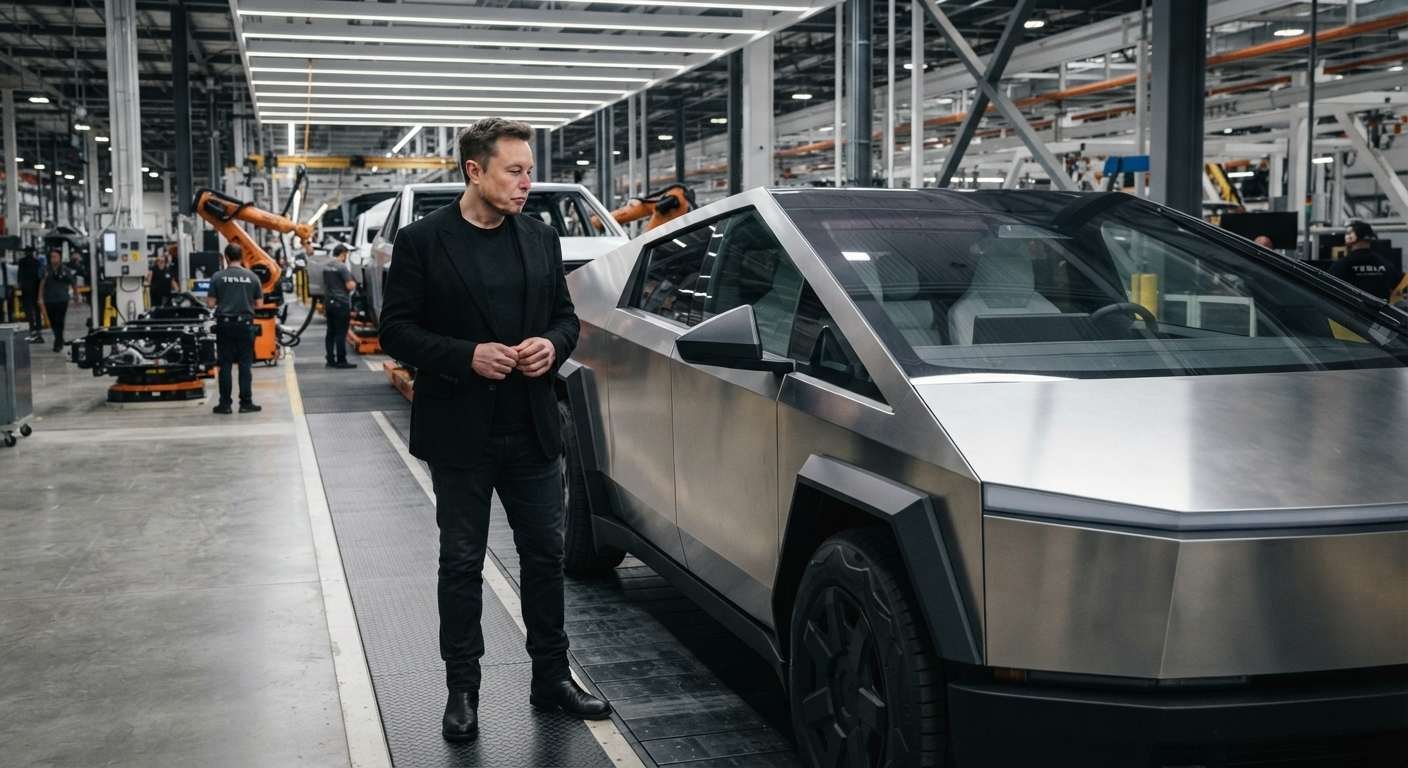
Just a few years after its highly publicized initial deliveries, the road has officially run out for the Tesla Cybertruck. In an unexpected announcement on November 6, 2026, Elon Musk stated that the EV pioneer will stop taking new orders and completely halt assembly lines for the polarizing pickup truck within the coming months.
As a platform dedicated to real-world satellite internet and mobile tech testing, the Exploraphones team has analyzed the primary architectural and market indicators behind this radical shift:
1. Sales Reality vs. The 250k Hype
When the radical wedge-shaped prototype first debuted in 2019, Musk confidently projected annual sales of 250,000 units. However, domestic registration data revealed a steep drop-off. By the close of the 2025 financial cycle, U.S. consumer demand plunged by 48%, signaling that the truck was struggling to break out of a niche collector market into high-volume commercial utility.
2. The Death of the Under-$40k Promise
Tesla’s baseline goal of providing an affordable, mass-market electric work truck below $40,000 never came to fruition. Following the quiet discontinuation of the entry-level Rear-Wheel Drive (RWD) trim, the lowest available window sticker jumped heavily to $92,490, while the performance-focused “Cyberbeast” pushed deep past six figures.
3. Manufacturing Bottlenecks and Quality Regressions

Forming the proprietary Ultra-Hard Stainless Steel exoskeleton turned out to be a persistent manufacturing bottleneck. Over its brief production run, the Cybertruck suffered multiple high-profile structural and software recalls, tracking issues with unintended accelerator sticking, wiper motor failures, and loose exterior cosmetic cladding.
Final Specifications Reference (Exploraphones Field Data)
While the Cybertruck’s commercial lifecycle was brief, it acted as a live engineering testbed for several radical automotive systems that will outlive the vehicle itself:
| Technical Metric | Dual Motor AWD | Tri-Motor “Cyberbeast” |
|---|---|---|
| Total Power Output | 600 Horsepower | 855 Horsepower |
| Akselerasi (0-60 mph) | 4.1 Seconds | 2.6 Seconds |
| Real-World Range Est. | 340 – 362 Miles | 320 – 340 Miles |
| Battery Architecture | ~123 kWh Structural Pack | ~123 kWh Structural Pack |
| Low-Voltage Grid | 48-Volt Full System | 48-Volt Full System |
| Steering Infrastructure | Steer-by-Wire & 4-Wheel | Steer-by-Wire & 4-Wheel |
The true legacy of this truck rests in its 48-volt electrical architecture and digital steer-by-wire mechanics (which replaces physical steering columns with localized redundant actuators). This digital chassis blueprint is what paves the way for Tesla’s next era.
Exploraphones Insight: An All-In Bet on Autonomous Rides
Tesla’s choice to cancel the Cybertruck isn’t a retreat; it’s a massive, calculated reallocation of capital toward AI infrastructure and autonomous transit.
High-volume manufacturing floor space at Gigafactory Texas is prime real estate. By sacrificing the low-volume Cybertruck line, Tesla frees up massive automated floor space to achieve scale for the Cybercab. The wheelless, pedal-free autonomous taxi is optimized for dramatically lower production costs and targets a global ride-hailing ecosystem worth trillions.
Fleet Support Notice: For existing owners, Tesla verified that it will maintain full supply chains for replacement parts, structural service support, and continuous Over-the-Air (OTA) software safety updates throughout the vehicle’s standard operational lifespan.
What are your thoughts on Tesla sunsetting the Cybertruck to go all-in on the Cybercab autonomous fleet? Let us know in the comments section below.