
Key Takeaways:
- No Onboard Charger (OBC): The production Cybercab lacks the internal power electronics required to convert AC power from a residential wall outlet into DC power for the battery.
- DC Fast Charging Only: Equipped with a concealed NACS port, the vehicle can only replenish its battery at high-voltage DC fast chargers like Tesla Superchargers.
- Restrictive Autonomy Clauses: Tesla’s mandatory $299/month software agreement requires the registered owner to sit inside the vehicle for every trip—prohibiting the car from driving itself to a Supercharger overnight.
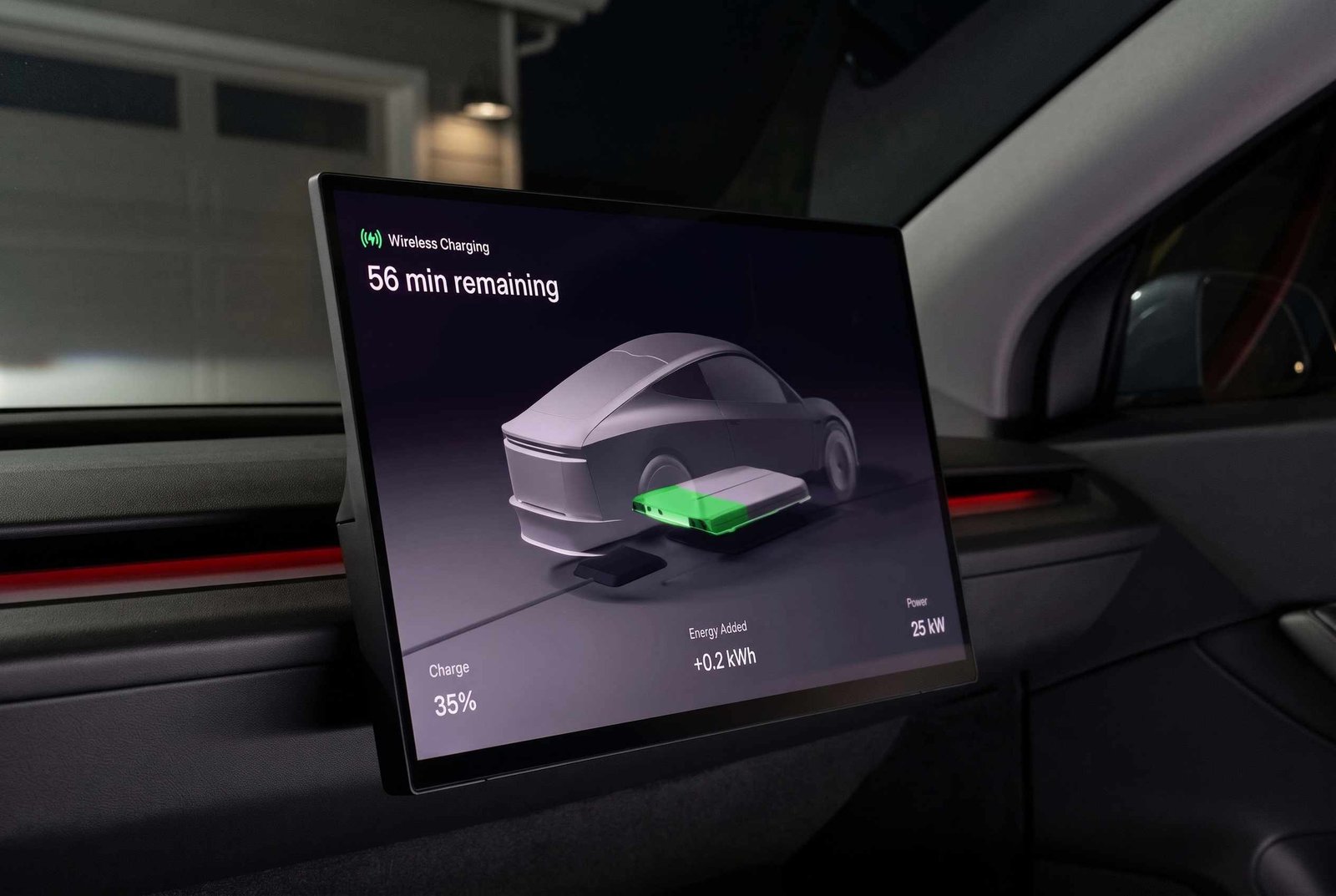
- Missing Wireless Hardware: Despite years of patents, FCC waivers, and demonstrations, Tesla’s inductive home charging pad still has no commercial release date or pricing ahead of December 2026 deliveries.
Tesla has officially opened orders for the $29,990 Cybercab, with initial retail deliveries scheduled to begin in Austin, Texas, in December 2026. However, achieving that sub-$30,000 price point required a major engineering trade-off that directly impacts private buyers: the vehicle cannot be plugged into a standard home garage.
Because the production Cybercab eliminates the traditional onboard charger, it relies exclusively on DC fast charging. Combined with the continued absence of Tesla’s long-promised wireless home charging pad, early adopters face significant logistical hurdles.

The Engineering Behind a DC-Only Architecture
When Tesla CEO Elon Musk first unveiled the Cybercab prototype in 2024, he stated the vehicle would omit physical charge ports entirely, relying purely on inductive wireless charging pads.
Production models operating in Tesla’s Austin fleet tell a different story. Every production Cybercab incorporates a North American Charging Standard (NACS) port hidden behind a panel in the rear bumper, which Tesla uses to plug the vehicles into standard Superchargers.
The core limitation lies beneath the charge port. As confirmed by Tesla engineers during the September 2026 Austin launch event, the Cybercab does not have an onboard charger (OBC). In standard electric vehicles, the OBC converts alternating current (AC) from the residential grid into direct current (DC) to charge the high-voltage battery pack.
Without an OBC, private Cybercab owners face strict infrastructure limitations:
- Incompatibility with Tesla Wall Connectors installed in residential garages.
- Inability to use Mobile Connectors on standard 120V (Level 1) or 240V (Level 2) household outlets.
- No access to public Level 2 AC chargers commonly found at shopping centers, offices, and parking garages.
From a commercial fleet engineering perspective, deleting the OBC is a logical cost-reduction strategy. It lowers the bill of materials, reduces curb weight, and eliminates thermal management requirements for AC-to-DC conversion. A commercial robotaxi operates out of centralized depots equipped with high-speed DC infrastructure, making an OBC redundant. However, transferring a fleet-optimized specification directly to retail consumers shifts those infrastructure costs onto the buyer.
How the Subscription Fine Print Complicates Ownership
The lack of home charging is compounded by the legal framework governing the vehicle’s operation. According to the Cybercab Autonomy Agreement and Order Agreement, retail buyers must adhere to strict operational rules:
- Mandatory Monthly Fee: Owners must pay a $299 monthly subscription for the vehicle’s autonomous driving system to function.
- Owner Liability: The contract places all operational responsibilities—including registration, insurance, parking, cleaning, and charging—squarely on the buyer, while requiring the vehicle to remain charged and connected for over-the-air (OTA) software updates.
- Physical Presence Requirement: Only the registered owner may use the Cybercab, and they must remain physically inside the vehicle for the entirety of every trip.
The subscription contract includes only one exception to the occupancy rule: the Cybercab is permitted to drive itself unoccupied to an official Tesla Service Center for scheduled maintenance. No such exception exists for charging.
Consequently, an owner cannot command their autonomous vehicle to drive itself to a nearby Supercharger at 2:00 AM while they sleep. Instead, the owner must physically accompany the two-seat vehicle to a Supercharger, sit inside the cabin for the duration of the charging session, and ride back home.
The Timeline of Tesla’s Unreleased Wireless Charger
The definitive hardware solution to this problem is the inductive wireless home charger Tesla has been developing for over three years. A review of public filings and company disclosures shows the technology is mature, yet commercially unavailable:
- March 2023: Tesla teased an image of a residential wireless charging pad during its Investor Day presentation.
- Late 2023: Chief Designer Franz von Holzhausen confirmed on Jay Leno’s Garage that Tesla was developing an inductive pad that allows owners to charge simply by parking over a mat in their garage.
- 2024: Tesla published patent filings for inductive charging architecture and released video footage following the Cybercab unveiling showing the robotaxi charging wirelessly at 25 kW with claimed power transfer efficiency exceeding 90%.
- February 2026: The Federal Communications Commission (FCC) granted Tesla a regulatory waiver to deploy ultra-wideband (UWB) radio positioning, allowing the Cybercab to align itself precisely over a ground pad.
Despite clearing engineering and regulatory milestones, Tesla has not announced pricing, installation requirements, or a retail launch date for the wireless pad. Notably, Tesla abandoned plans to offer wireless charging for the Cybertruck in 2025, even after shipping trucks with the necessary internal inductive receiver connectors. With Cybercab deliveries weeks away, early buyers have no confirmed path to first-party home charging.
Viable Alternatives for Private Buyers
If Tesla does not launch its wireless pad alongside the Cybercab in December, private owners are left with impractical or expensive workarounds:
- Tesla Fleet Depots: Municipal filings in Austin show Tesla is constructing a mega-hub on St. Elmo Road featuring 48 V4 Supercharger stalls in Phase 1, followed by power cabinets supporting 80 wireless charging bays in Phase 2. Even if Tesla grants retail owners access to these depots, the contractual occupancy rule still requires the owner to commute to the hub and wait inside the car.
- Third-Party Residential DC Chargers: Home DC chargers bypass the need for an onboard charger by performing the AC-to-DC conversion inside the wall unit. For example, Sigenergy offers a 25 kW bidirectional DC charging module integrated into its SigenStor home battery ecosystem, and Lunar Energy recently announced a 25 kW residential DC charger slated for mid-2027. However, these enterprise-grade residential systems require substantial capital investment and rely on Tesla permitting third-party DC handshake protocols on the tightly controlled Cybercab platform.
Consumer Value Analysis
The Cybercab’s charging limitations highlight the friction of selling a purpose-built commercial fleet vehicle to private consumers to satisfy a corporate deadline. Musk previously pledged to sell a sub-$30,000 vehicle to customers before 2027, even while acknowledging on Tesla’s Q3 earnings call that the vast majority of Cybercabs will remain Tesla-owned fleet assets.
For early adopters in Austin living minutes away from a V4 Supercharger, relying on public infrastructure may be manageable. For the broader market, paying $29,990 upfront plus $299 per month for an autonomous car that cannot charge in a home garage—and is contractually barred from driving itself to a public charger—delivers noticeably less day-to-day convenience than a standard Tesla Model 3 paired with a home Wall Connector.
To make private Cybercab ownership practical, Tesla must either commercialize its 25 kW wireless home charging pad immediately or amend its autonomy contract to allow unoccupied charging trips.