
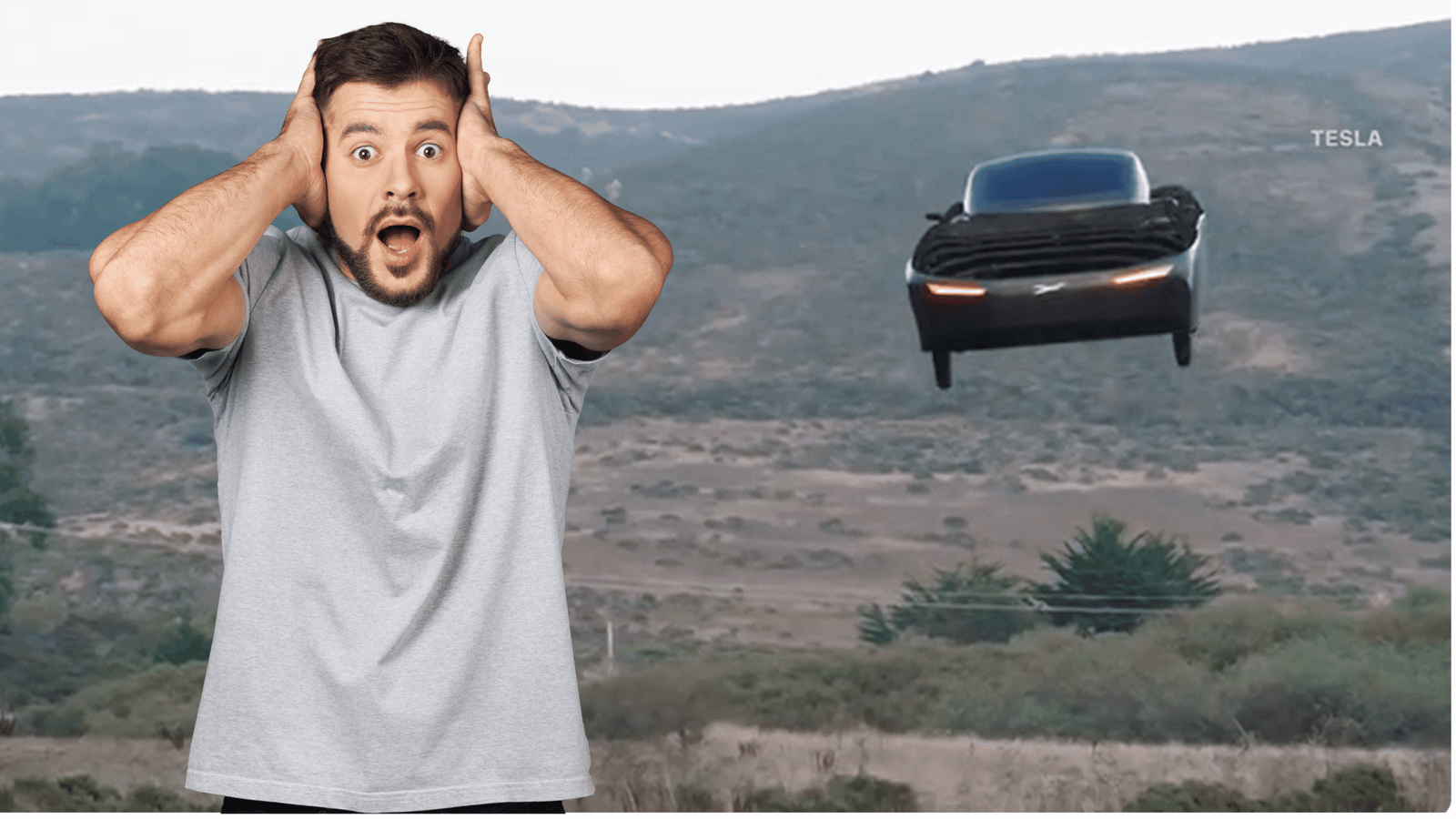
Tesla CEO Elon Musk on Thursday unveiled what he described as a flying car at a Texas test facility owned by SpaceX.The vehicle was the long-delayed new Tesla Roadster, a two-seat sports car.
Musk said it can go from 0 to 60 mph in under a second and, using technology borrowed from SpaceX, leave the ground.
During the live demonstration, the Roadster had no driver inside.”To make sure we don’t kill anyone,” Musk told the crowd.
“Success is not guaranteed. I mean that.
It’ll probably work, but if it doesn’t work, we’re at a safe distance.”In the demo, the car used suction underneath to climb a steep ramp, hang upside down, then spin off, flip in the air and land using air jets. In a second stunt, it jumped over a line of parked Teslas and used rear-mounted jets to hit 60 mph.
How it works, according to Musk: 10 thruster nozzles powered by “ultra high-pressure air tanks.” He called it “what happens when you have a collaboration with the world’s best car company and the world’s best rocket company.
“Musk said production would start in 2028. Tesla has a history of missing its own timelines by years.He also told fans the live audience was intentional: “We need an audience to prove that it’s not AI… you guys can tell people you saw it with your eyes, because what you see with your eyes, you will not believe.”Can it actually fly? That remains unproven.
Thursday’s event showed short hops and controlled flips, not sustained, long-range flight.That distinction matters.
The industry for electric vertical take-off and landing aircraft, or eVTOLs, has made progress, but making a street-legal car that can also fly is a fundamentally different engineering problem.”Aircraft are extremely sensitive to weight, whereas with ground vehicles you want them to have bumpers and crumple zones and all that,” Roger Connor, curator for vertical flight at the Smithsonian’s National Air and Space Museum, told CNN before the event.
“Inevitably, something that is a hybrid between the two is going to be a poor performing aircraft and a poor performing vehicle, and also quite expensive.
“Other attempts highlight the trade-off. California startup Alef has a vehicle that gets airborne with eight propellers, but it weighs just 254 pounds and carries one person who must weigh less than the vehicle itself.
Alef CEO Jim Dukhovny said ahead of Tesla’s demo that getting off the ground was “absolutely 100% feasible,” but added: “The hardest part on all eVTOLs is the transition from vertical to forward.
It needs to be extremely careful, making sure you do not lose lift, and making sure it’s very stable.”As Connor put it: “We’re not talking about sustained flight. We are literally talking about hopping.”