
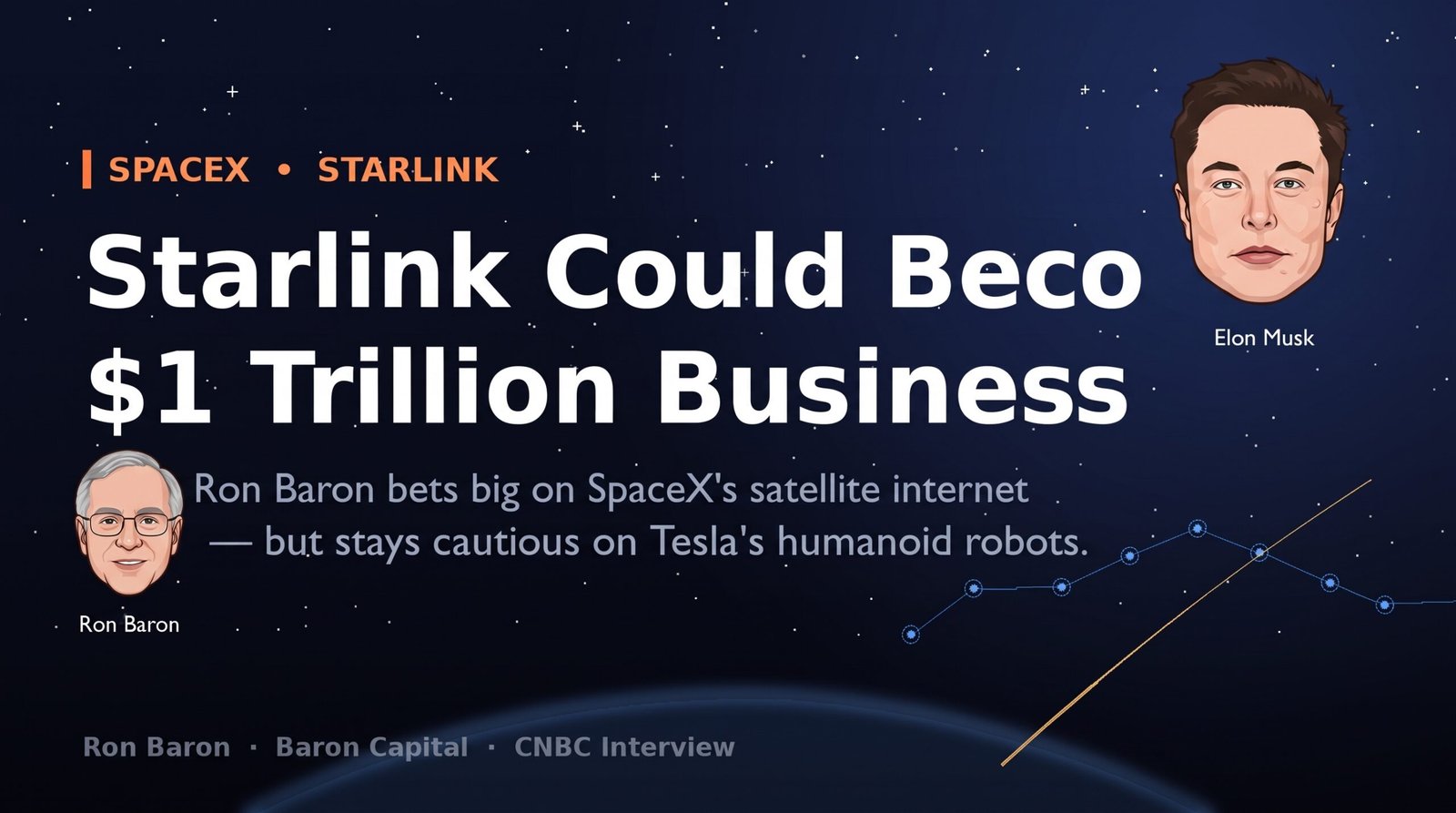
Veteran investor Ron Baron, founder of Baron Capital, believes SpaceX’s Starlink division has a realistic path to generating roughly $1 trillion in annual revenue within the next decade — a figure that would place SpaceX among the most valuable companies in history.
A Multi-Trillion-Dollar Valuation Thesis
Speaking in a recent CNBC interview, Baron laid out the math behind his bullish outlook. If Starlink can reach that trillion-dollar revenue mark with EBITDA margins in the $700–800 billion range, applying a reasonable valuation multiple could push SpaceX’s overall worth to somewhere between $14 trillion and $15 trillion. For context, SpaceX is currently valued at under $2 trillion, meaning Baron is projecting roughly a sevenfold increase in value.
Baron, whose fund reportedly holds around $25 billion worth of SpaceX shares, has spent time studying the company’s growth trajectory closely before arriving at this forecast.
Falling Launch Costs Are the Foundation
Much of Baron’s optimism is tied to the dramatic decline in the cost of sending payloads into orbit. He pointed out that launching a kilogram of cargo into space cost around $18,700 back in 2010. The Falcon 9 brought that down to roughly $2,700, and SpaceX’s heavy-lift rockets pushed it further down to about $1,500.
The real game-changer, according to Baron, is the next-generation rocket system — widely understood to be Starship — which he expects could eventually cut launch costs to somewhere between $100 and $150 per kilogram. Cheaper launches would let SpaceX deploy a vastly larger satellite fleet at a fraction of today’s cost.
AI Demand Could Be the Real Growth Engine
Beyond the rocket economics, a key part of the bull case centers on artificial intelligence. As AI agents and connected systems generate ever-increasing volumes of data traffic, global demand for high-capacity connectivity is expected to surge. To meet that demand, Starlink would need to scale toward a constellation of roughly 100,000 satellites, with the fleet replaced approximately every five years as technology advances.
This vision depends heavily on the successful, frequent deployment of Starship V3, since only dramatically cheaper and more frequent launches could make a satellite network of that scale economically viable. Whether Starship can deliver reliably at that pace remains the biggest open question — and the milestone worth watching most closely.
From 15 Million Users to 300 Million
Baron expects consumer subscriptions to represent only about 30–35% of Starlink’s future revenue, with the bulk coming from government contracts, enterprise clients, and mobile connectivity services. He projects Starlink’s subscriber base could grow from around 15 million today to as many as 300 million over the next ten years.
Market Reaction Stays Cautious
Despite the ambitious long-term projections, near-term investor sentiment has been mixed. SpaceX shares have traded around the $153 mark, up modestly on the day, with the company’s market capitalization sitting near $2 trillion. Retail trading activity has actually leaned toward selling over buying, suggesting many everyday investors remain cautious even as institutional voices like Baron stay bullish.
Tesla: Bullish on FSD, Skeptical on Robots
Baron also shared his views on Tesla, where he remains optimistic — largely due to the growing adoption of Full Self-Driving (FSD) technology. He noted that FSD usage has expanded to around 1.4 million users, with annual growth near 55%. He also pointed to Tesla regaining market share as legacy automakers slow their EV commitments.
However, Baron is notably less enthusiastic about Tesla’s humanoid robot ambitions. While CEO Elon Musk has repeatedly suggested the robotics business could eventually outgrow Tesla’s core automotive operations, Baron said he isn’t factoring much value into that potential yet, emphasizing instead Tesla’s strengths in EVs and energy storage technology.
Bottom Line
Ron Baron’s forecast paints an extraordinarily bullish picture for SpaceX and Starlink, built on a combination of falling launch costs, exploding AI-driven data demand, and aggressive satellite expansion. But the thesis carries real execution risk — it hinges almost entirely on Starship V3 performing as promised. Investors watching this story should keep an eye on Starship’s launch cadence and reliability as the clearest signal of whether Baron’s trillion-dollar Starlink vision is achievable.
Only when you sign up through this link (Official from Starlink).