
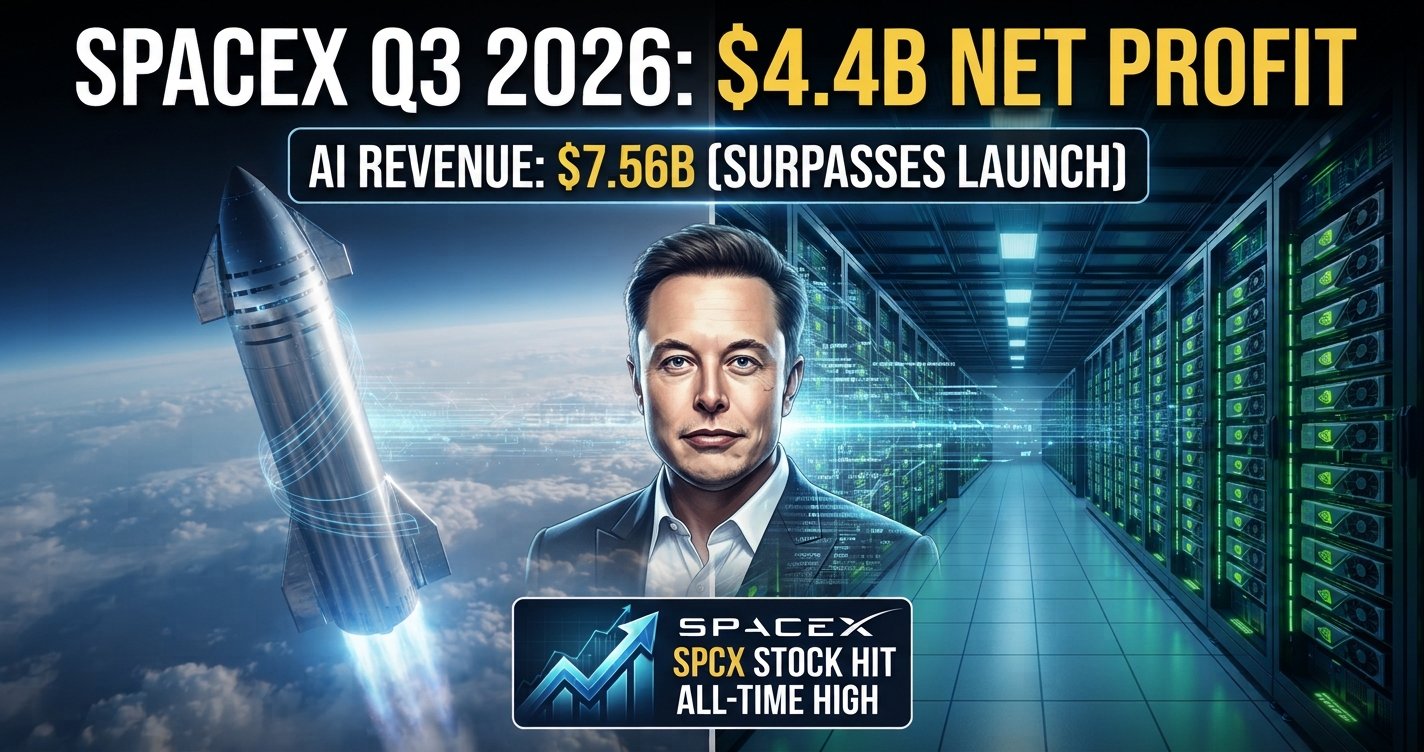
LOS ANGELES, CA — SpaceX (NYSE: SPCX) delivered its first-ever quarterly net profit as a public company on Tuesday, posting $14.58 billion in revenue and $4.40 billion in net income for the third quarter of 2026. The financial results significantly outpaced Wall Street consensus estimates, which had projected revenue closer to $12.7 billion.
The blowout quarter represents a sharp reversal from the $1.1 billion net loss recorded during the same period last year. However, the primary catalyst for this financial turning point was not the company’s traditional launch services, but an aggressive pivot into artificial intelligence infrastructure supply.
The Financial Breakdown: AI Overtakes Satellites and Launch
According to the official SpaceX Q3 2026 Investor Relations Report, the company’s capital allocation and revenue streams have undergone a structural transformation. For the first time, compute processing services have eclipsed aerospace operations as the primary revenue driver.
- SpaceX Super Intelligence (SI): Generated $7.56 billion in revenue, marking an 830% year-over-year increase. The segment swung to a $431 million operating profit, fueled by high-margin GPU compute rentals to enterprise AI developers, including Anthropic and Alphabet’s Google.
- Starlink Connectivity: Recorded $5.25 billion in revenue. The satellite internet constellation remains a critical cash-flow anchor, expanding its global user base to 13.6 million active subscribers.
- Launch & Aerospace Operations: The core rocket business—consisting of Falcon 9 commercial flights, government payloads, and NASA contracts—saw a modest 6% year-over-year revenue increase, acting as a mature, capital-intensive utility rather than a high-growth segment.
The xAI Integration and the “Colossus” Infrastructure
The infrastructure underpinning SpaceX’s AI revenue surge stems directly from its February 2026 acquisition of xAI. By absorbing xAI’s operations, SpaceX gained direct custody of the “Colossus” supercomputing clusters located in Memphis, Tennessee.
SpaceX disclosed that it directed $16.4 billion of its $19.6 billion Q3 capital expenditures exclusively toward digital infrastructure. The company plans to scale these facilities by deploying 200,000 Nvidia Grace Blackwell systems monthly through the remainder of the fiscal year.
Enterprise clients are utilizing this centralized ground infrastructure to train large language models. Financial filings indicate that Google alone accounted for a substantial portion of the segment’s monthly billing, securing dedicated infrastructure to support its native multi-modal model training pipelines.
Forward Outlook: The $1 Trillion ARR Target and Tesla Merger Talks
During the post-earnings conference call, SpaceX CEO Elon Musk introduced an aggressive growth target, projecting that the company’s Annual Recurring Revenue (ARR) will expand from its current run rate of $58 billion to between $500 billion and $1 trillion by the end of 2027.
Musk stated that this trajectory relies on a symbiotic relationship between SpaceX’s two major divisions: leveraging the upcoming weekly flight cadence of the Spaceship launch vehicle to eventually deploy space-optimized, low-latency compute nodes directly into orbit, bypassing terrestrial data center real estate constraints.
In a unexpected disclosure during the call, Musk also confirmed that independent special committees have been established by the boards of both SpaceX and Tesla Inc. to explore the feasibility and structural regulatory compliance of a potential corporate merger.
Editorial Analysis & Institutional Risks
While the financial markets responded favorably to the earnings surprise, institutional analysts urge caution regarding SpaceX’s long-term valuation modeling.
The $1 trillion ARR projection requires an unprecedented 8.5x expansion over a 15-month horizon. Achieving this depends entirely on sustained, unmitigated demand for hyperscale AI processing. If the broader enterprise AI market experiences a cyclical correction or a cooling of infrastructure spend, SpaceX’s heavy capital investments in hardware could leave the company exposed to significant depreciation risks.
Furthermore, any formal merger discussion between Tesla and SpaceX faces intense regulatory scrutiny from antitrust agencies, alongside potential governance friction regarding fiduciary duties to distinct shareholder groups across both entities.
Get $100 in Cash or Service Credit
I invited you to Starlink — high-speed internet backed by the world’s most advanced satellite constellation. Starlink keeps you connected:
- At home — Reliable Residential internet available even in the most rural and remote locations.
- On the go — Connectivity for road trips, camping, and remote work without dead zones.
It’s easy to get started.