
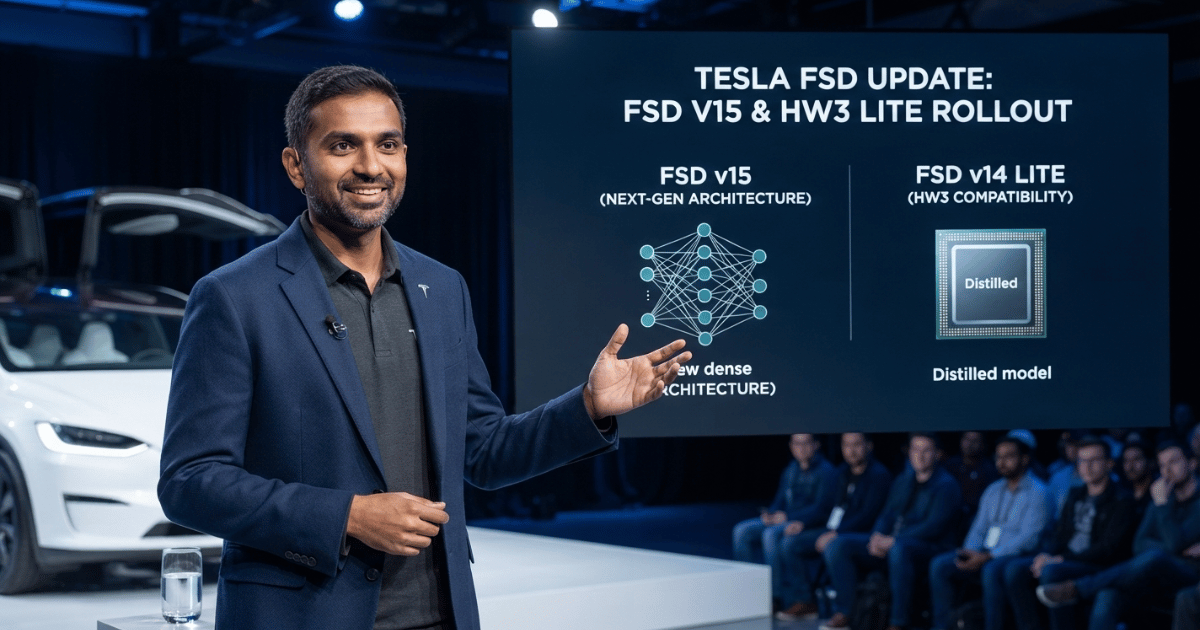
Tesla’s VP of AI, Ashok Elluswamy, has officially signaled a major architectural shift for the Full Self-Driving (FSD) ecosystem with the upcoming FSD v15 release and the imminent rollout of FSD v14 Lite for legacy vehicles. This dual-track strategy highlights a rapid commercial acceleration into autonomous ride-hailing while navigating the hard compute limitations of older vehicle hardware.
As Tesla prepares its internal Robotaxi fleet for broader public operations, these upcoming software builds serve as a critical test for whether the company’s “vision-only, end-to-end AI” thesis can achieve scalable, unsupervised autonomy.
1. FSD v15: Massive Scaling and 24/7 Robotaxi Integration
The centerpiece of Tesla’s immediate autonomy roadmap is FSD v15, which serves as the foundational core for its driverless operations:
- Round-the-Clock Commercial Ops: Elluswamy confirmed on X (formerly Twitter) that the v15 software update will eliminate operational boundaries, allowing Robotaxi networks to operate 24/7.
- Tens of Billions of Parameters: Shifting away from smaller, isolated code blocks, v15 utilizes a massive single neural network. It tightly couples vision processing directly to driving controls using computational scaling powered by the Dojo supercomputer.
- Proactive Hazard Avoidance: The model focuses heavily on safety scaling. This features much earlier hazard prediction, quicker response times, and specialized Automatic Collision Evasion routines designed to prevent accidents even during manual driver oversight.
2. Legacy Support: FSD v14 Lite Rollout for Model S & X (HW3)
For existing Tesla owners, the focus centers on the long-delayed deployment of FSD v14 Lite for flagship Hardware 3 (HW3/AI3) vehicles:
- Imminent Distribution: Speaking briefly during a recent Cybercab showcase event, Elluswamy admitted the update was expected to deploy slightly sooner (“Oh, I thought it was supposed to go out last week”), clarifying that the launch for older Model S and Model X vehicles is now immediate.
- Parameter Distillation: The “Lite” tag points to heavy model compression. This distillation ensures core v14 features can execute reliably within the lower memory bandwidth and processing ceilings of HW3 compared to its successor.
Architectural Contrast: HW3 vs. HW4/AI4 in the Era of FSD v15
| Aspect / Specification | Hardware 3 (HW3 / AI3) | Hardware 4 (HW4 / AI4) |
|---|---|---|
| FSD v15 Compatibility | ❌ Not Compatible | Fully Supported |
| Primary Software Variant | FSD v14 Lite (Distilled Parameters) | FSD v14 Full / FSD v15 Platform |
| Operational Blueprint | Supervised Driving (Requires Attention) | Unsupervised Foundation / Robotaxi Ready |
| Compute & Memory Overhead | Limited (~15% processing depth of HW4) | Built for >10 Billion Parameter Networks |
Added Value: Critical Technical and Market Perspectives
To truly understand what these announcements mean beyond the surface headlines, we must analyze the structural realities facing Tesla:
1. The “Hardware Caste System” is an Inevitable Software Reality
Tesla’s decision to fork its software pipeline into a “Lite” version for HW3 vehicles is definitive proof that pure-vision autonomy requires exponential compute growth. While Tesla deserves credit for continuing to support its older user base with v14 Lite, it is clear that truly unsupervised driving is out of reach for legacy chips. This highlights a broader challenge for the automotive sector: the lifecycle of software-defined intelligence moves at a tech-industry pace, vastly outpacing the mechanical lifespan of a car.
2. The Bottleneck is Regulatory Validation, Not Just Model Parameters
A 24/7 driverless model running tens of billions of parameters is a remarkable technical feat, but the real hurdle remains liability and safety auditing. Transitioning to round-the-clock operations introduces challenging edge cases, such as extreme nighttime weather conditions or unmapped road construction. Regulatory bodies like the NHTSA will demand vast, verifiable disengagement data before granting commercial permits outside heavily restricted, pre-mapped geofences.
3. Strategic Summary for Consumers
- For HW3 Owners: Expect v14 Lite to deliver a highly polished, comfortable supervised experience. However, manage expectations regarding future autonomous robotaxi eligibility, as the hardware lacks the necessary overhead for unmonitored driving.
- For HW4/AI4 Owners and Buyers: Monitor the rollout of FSD v15 closely. It will serve as the true benchmark for how effectively Tesla’s end-to-end network handles complex, dynamic urban environments in real-world scenarios.