
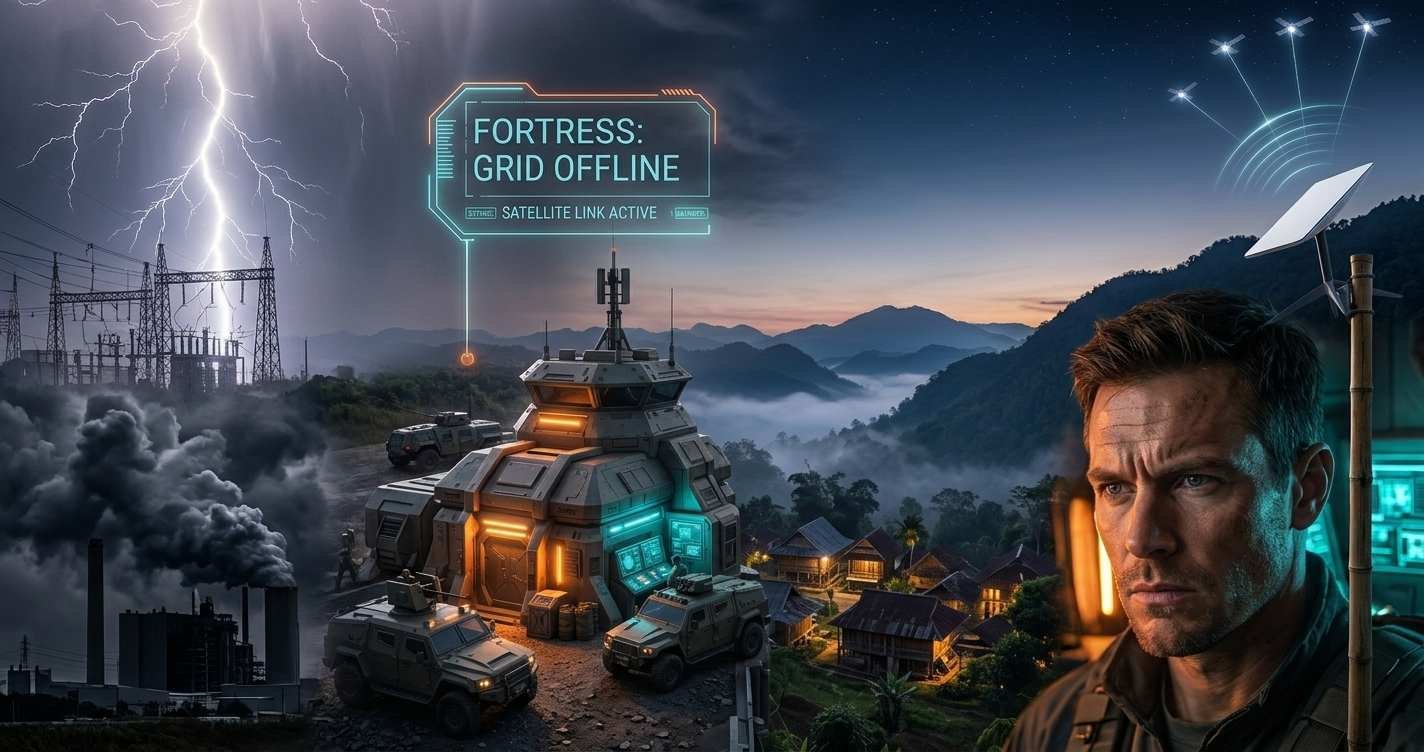
The global geopolitical and infrastructure landscape is undergoing a massive paradigm shift. Not long ago, a thread I shared on the Threads platform went viral, sparking intense debates and racking up millions of views. The catalyst was a startling collective realization: the civilian municipal infrastructure we rely on every single day is incredibly fragile.
As someone who has been living and running digital operations completely off-grid for three years from the highlands, energy independence and decentralized connectivity are part of my daily life. Running 2x Starlink Mini setups that pull an average of 220 Mbps, I see firsthand how independent infrastructure rewrites the rules.
But when the world’s most powerful military institution—the Pentagon—orders its bases to prepare for 90 days without a civilian power grid, you know it is no longer just a hobby for preppers or tech enthusiasts. It is an urgent strategic necessity.
Project “FORTRESS America”: The Pentagon’s Bold Move Against Grid Vulnerabilities
Recent directives from the U.S. Department of Defense confirm the worst fears of infrastructure security experts. U.S. Defense Secretary Pete Hegseth officially announced a sweeping new initiative named FORTRESS America (Federal Operations for Resilience, Troop Resources, Energy, Supply, and Survivability).
According to internal Pentagon planning documents reported by credible news outlets like Fox News Digital and Fortune, this directive legally mandates all primary military installations across the continental United States to be capable of operating completely independently for a minimum of 90 days if the civilian municipal grid collapses due to warfare, sophisticated cyberattacks, or physical sabotage.
The 90-day survival mandate extends far beyond backup diesel generators. It encompasses long-term independent micro-nuclear reactors, large-scale battery storage, decentralized water supplies, and most crucially: uninterrupted communication channels.
Pentagon Chief Spokesperson Sean Parnell, who is leading the implementation of the FORTRESS directive, stated bluntly to reporters:
“We don’t want to rely on standard civilian municipal infrastructure to run our national defense. We just simply can’t. It’s an intolerable risk. Power is combat now. Without power, you lose communications, you lose water, you lose logistics, you lose assembly lines, and you lose command structures.”
The Spectrum Misconception: Why “Nationalizing Starlink” Misses the Point
When the grid vulnerability issue gained mainstream attention, internet users across the U.S. immediately called for Uncle Sam to “nationalize Starlink” for homeland security. This sentiment intensified after SpaceX aggressively acquired a 14MHz block of the 800MHz spectrum for $8 billion—following Skydance’s landmark merger with Warner Bros. Discovery—which sent legacy telecom giants (Verizon, AT&T, T-Mobile) plunging by a combined $39 billion in market cap in a single afternoon.
However, the general public completely misses the underlying technical reality of wireless spectrums:
- Low-Band (800MHz) is COVERAGE: Low frequencies excel at penetrating thick concrete walls and traveling deep into remote valleys. However, they lack the raw bandwidth needed for massive data loads.
- Mid-Band (2GHz and up) is CAPACITY: This is the frequency range required for data-heavy tasks like high-definition video streaming and multi-party video conferencing.
Legacy telecommunications companies have sat on the 800MHz band for over 20 years, yet rural America and deep pockets of global archipelagos are still plagued by persistent dead zones. We do not have a coverage problem; we have a “who owns the last 100 meters” problem.
This is where SpaceX’s true disruption lies. Backed by their planned deployment of 15,000 Gen2 satellites and thousands of ground sites—slated for final FCC closing by November 2027—they are building a space-native fourth major carrier network that will reach full maturity by 2028.
Infrastructure Arbitrage: Immediate Off-Grid Solutions Today
While the Pentagon’s blueprint requires years of bureaucratic execution and billions in capital to deploy micro-reactors and independent nodes, practical off-grid resilience is available to small businesses and properties right now.
At my homestay business in Toraja, waiting for a multi-year carrier network to mature in 2028 is not an option. When legacy fiber ISPs hand out absurd infrastructure installation quotes (mirroring the famous $129k fiber installation quote in rural Texas that went viral online), a simple $149 Starlink dish mounted on a local bamboo pole in rural delivers identical—if not superior—performance.
Today, I run 2 Starlink Mini units to fully power the connectivity needs of 15 homestays, pumping out a reliable 220 Mbps entirely off-grid. If the municipal power grid collapses tomorrow morning, our local solar arrays keep our dishes powered, and our business remains seamlessly connected to the global economy. That is the power of infrastructure arbitrage.
Secure Your Off-Grid Freedom Today (Referral & Business Promo)
If you are ready to secure your own independent backup network and break free from fragile local lines, you can get a $100 discount or service credit on your next bill by purchasing your setup via my Official Starlink Referral Link Here. SpaceX offers a risk-free 30-day trial period, meaning if the performance does not live up to your expectations, you can return the hardware for a full refund. Furthermore, if you run a rural business, boutique lodging, or want to support an isolated community, this exact hardware can be leveraged into a local commercial ecosystem through Starlink for Communities—allowing you to easily distribute high-speed bandwidth to your neighbors while generating a steady, hands-off secondary income stream.